
Smarter Storage Ideas for Busy Commercial Kitchens
Published by Guest Contributor on 22nd Oct 2026
How to Choose the Right Storage Containers for a Commercial Kitchen
Storage problems in a commercial kitchen usually aren't caused by a lack of containers. They're caused by using the wrong container in the wrong place.
A restaurant might have bags of flour sitting on shelving, half-empty cartons taking up valuable dry-store space and a collection of mismatched tubs that can't be stacked properly. Add a busy delivery day and the storage room can become difficult to navigate surprisingly quickly.
The solution starts with looking at what is being stored, how often staff need it and how it moves through the kitchen.
Start With What You're Actually Storing
A 20kg bag of flour, fresh produce and packaged takeaway supplies have very different storage requirements.
Dry ingredients that are used constantly need to be accessible. Fresh food may require food-grade containers suitable for refrigerated storage. Packaged supplies need organisation but don't necessarily require the same container as ingredients that come into direct contact with the plastic.
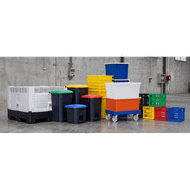
For restaurants, bakeries and catering operations handling a mix of these items, heavy-duty plastic storage containers are available in configurations ranging from food storage boxes and plastic crates through to mobile ingredient bins and large bulk storage tubs.
The important part is matching the container to the job rather than buying one style for everything.
Food Contact Changes the Requirements
If food will come into direct contact with the container, check that the specific product is manufactured from a suitable food-grade material.
Richmond's food storage range includes food-safe crates, food storage boxes, ingredient bins, buckets and other products intended for commercial food handling. Applications include restaurants, bakeries, commercial kitchens, food manufacturing and produce handling.
It's also important not to assume that every plastic crate is automatically food safe. Richmond specifically notes, for example, that black crates manufactured from recycled material aren't suitable for direct food contact.
That distinction matters in a working kitchen.
A container used for wrapped supplies has different requirements from one holding vegetables, dough ingredients or other unpackaged food.
Use Stackable Containers Where Floor Space Is Tight
Storage rooms in hospitality venues rarely have unlimited space.
Stacking allows a business to use the height of its shelving and storage areas rather than allowing containers to spread across the floor.
The design of the container matters here. A purpose-built stackable crate supports the container above it rather than placing that load directly onto its contents.
Stack-and-nest crates go one step further. When they're loaded, they can be positioned to stack. When they're empty, they can be rotated and nested inside each other.
Richmond's range includes 32L, 52L and 68L stack-and-nest crates manufactured from polypropylene, with food-grade options available. Compatible lids and transport dollies are also available.
That can be particularly useful for catering businesses and kitchens where container demand changes throughout the week. Full crates can be stacked during busy periods without leaving the business with towers of empty containers taking up space afterwards.
Bulk Ingredients Need a Different Approach
Flour is a good example of why storage should be selected around the ingredient.
In a bakery or high-volume kitchen, repeatedly lifting large ingredient containers or working directly from bags can become inefficient. Frequently used ingredients are better kept close to the preparation area in a container designed for that purpose.
Mobile ingredient bins combine bulk storage with wheels so ingredients can be repositioned rather than carried.
Richmond's current range includes 81L, 102L and 120L mobile ingredient bins designed for dry goods such as flour, sugar and grains. They use food-grade plastic, clear sliding lids and integrated castors, and are designed to fit beneath many standard workbenches.
For a bakery using flour throughout the day, that's a much more considered solution than simply placing another general-purpose tub on a shelf.
Think About the Empty Container Too
A storage container still takes up space when there's nothing in it.
This is easy to overlook when planning a kitchen, particularly for businesses that receive or move stock in reusable crates.
Nestable containers solve a specific problem. Instead of occupying their full external volume on the return journey or while waiting to be reused, empty crates fit inside one another.
Richmond's dedicated nesting crates, for example, are made from food-grade polypropylene and are available in 13.5L and 22.7L capacities. They're intended for repeated storage and handling across food processing, hospitality, warehousing and retail environments.
For businesses dealing with high container turnover, the amount of space occupied by empty containers can be just as important as their capacity when full.
Consider How the Container Will Be Cleaned
Commercial food storage needs to work with the kitchen's cleaning routine.
Smooth plastic surfaces are generally straightforward to wash, but container shape matters too. Complicated internal corners and damaged surfaces can make cleaning more difficult.
Food containers should be inspected regularly for cracks, excessive wear or damage that makes them difficult to clean properly.
Material also matters. Food-grade plastic containers are commonly used in commercial kitchens partly because they're resistant to moisture and designed to withstand repeated handling and cleaning. Richmond's food storage products are intended for both wet and dry food applications, including produce, seafood, dry ingredients and prepared food.
Build the Storage System Around the Kitchen
A café, bakery and large restaurant shouldn't have identical storage systems.
A café may need compact containers for ingredients and stackable crates for packaged supplies. A bakery may get more value from mobile flour bins and bread crates. A large restaurant might need separate systems for its cool room, dry store, preparation areas and incoming stock.
Before buying more containers, look at three things:
- What is being stored? Consider volume, weight and whether the contents will directly contact the container.
- Where is it being stored? Measure shelves, under-bench areas, cool rooms and available vertical space.
- How does it move? Consider whether the container stays in one place, is carried between stations or regularly travels between storage and preparation areas.
Those answers make it much easier to decide whether the kitchen needs a stackable box, nesting crate, mobile ingredient bin or another storage format.
Better Storage Starts With the Workflow
Good commercial kitchen storage should make the working day simpler.
Frequently used ingredients should be easy to reach. Containers should fit the available space. Food-contact products should be suitable for that purpose. Empty crates shouldn't consume more room than necessary, and bulk ingredients shouldn't be harder to move than they need to be.
Getting those basics right won't change what's on the menu, but it can make the space behind it considerably easier to manage.